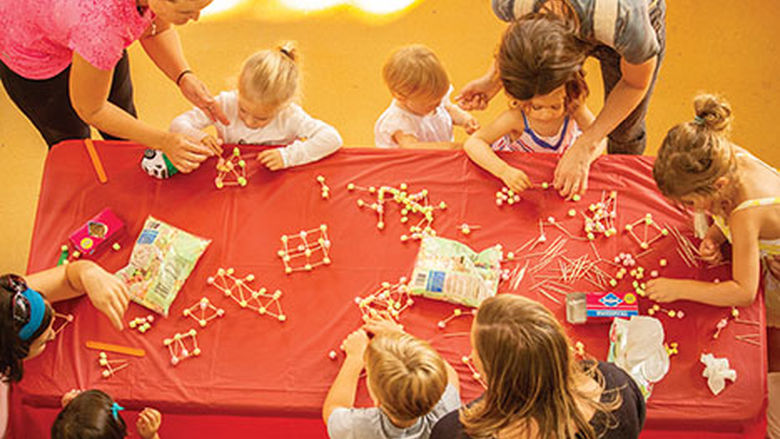
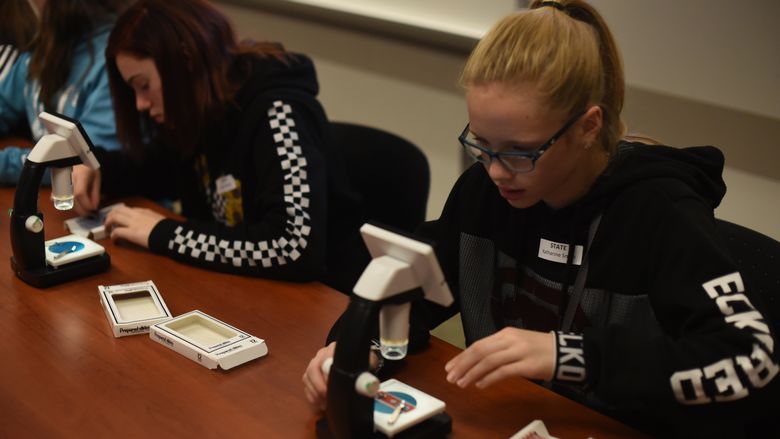
Katharine Smith, a seventh-grade student in the Youngsville School District, takes a close look at a specimen during a 21st Century Kids activity at Penn State Behrend. 21st Century Kids brings youth from rural populations to the college, allowing them to experience a college setting and participate in hands-on STEM workshops taught by Penn State Behrend faculty members and leaders from local STEM-focused businesses.
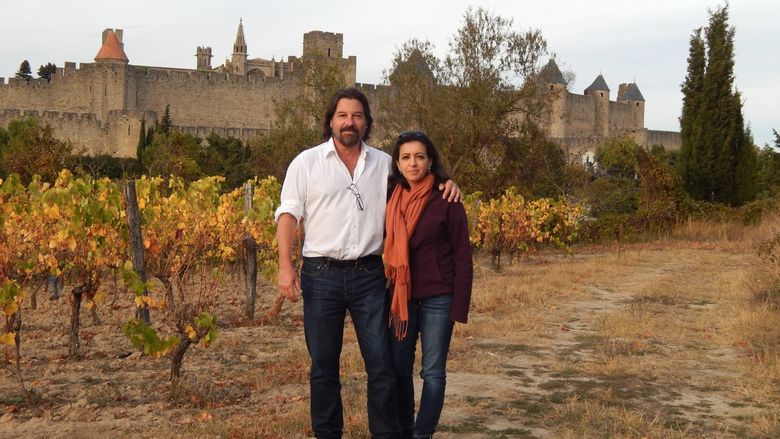
Penn State anthropology alumnus Dr. Charles Stanish (1979) and his wife, Garine Babian, pictured in a 2017 visit to Carcassonne, France. The couple recently created an endowment to encourage faculty/student research.
Avi Loeb, chair of the astronomy department at Harvard University, discussed the search for alien life during a Nov. 1 Speaker Series program at Penn State Behrend.
Accordionist Merima Ključo and guitarist Miroslav Tadić make up Aritmia, and they will bring their unique sound to Penn State Behrend on Wednesday, Nov. 6, to perform as part of Music at Noon: The Logan Series.
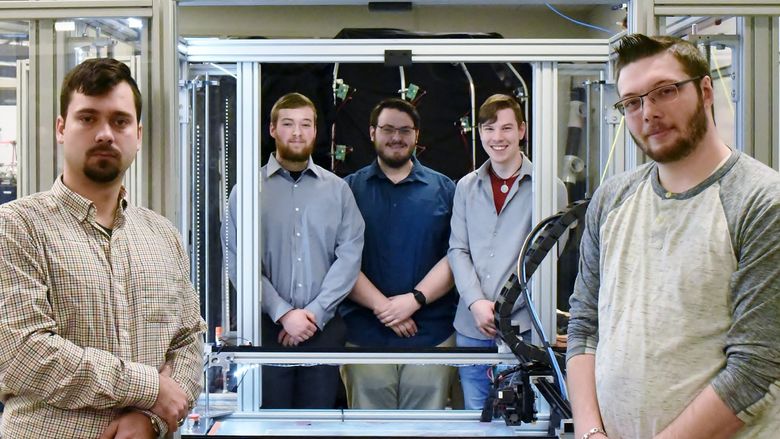
Left to right, John Nowakowski, Ryan Hutchinson, Michael Gibilterra, Elijah Thompson and Mike Paul worked together to build a large-format 3D printer from scratch in Penn State Behrend's Innovation Commons. The printer, which is now operational and available for public use, has a build volume of one cubic meter, and its footprint is roughly 1.5 by 1.5 by 2 meters. Any item within that range can be printed, from simple parts to full-sized 3D scans.